Thursday, August 24, 2006

Killington Hall, Killington

Killington Hall
Killington
Cumbria

Killington Hall lays in the small village of Killington sandwiched between Sedbergh and the M6 motorway. The hall is sited opposite the 14th century church of All Saints down a private road. It's attached to a 17th century hall house and is a ruinous state.


Built in the early 1400's, the original pele tower was sited over the top of an earlier 14th century moated site, and consisted of a three storey defensive structure. The crenellations have long since gone, as has most of the top floor.


The tower, still attached to the house which is inhabited to this day, has no structure within its walls. The floors have long since collapsed, and the roof is also gone. The fine sand stone windows are still intact, and the moat is little more than a boggy stream surrounding the tower on three sides.

Kilchurn Castle, Glenorchy and Inishail

Kilchurn Castle
Glenorchy and Inishail
Lochawe
Scotland

Sometimes referred to as Kilcairn Castle, the building was erected in around 1450 by Sir Colin Campbell, first Lord of Glenorchy. It started life as a tower house with a strong surrounding wall, but by 1500, a range and hall had been built on the South side of the castle. Further additions were made right through to the 1600's.

When the castle was originally built, it was on it's own small island, much as Castle Stalker is today. However, as the Loch has changed over the ensuing 600 years, the island is no more and the castle finds itself on the shores of the loch.

During the Jacobite rebellions of 1717 and 1745, the castle was garrisoned by government troops. It was more or less abondonded by the Campbells in around 1740, although ownership was maintened by the family. In 1760, the castle's demise was sounded when a severe storm resulted in a lightining struck tower falling into the courtyard. The upturned tower remains there to this day. The castle, as a result of the storm damage was fully abondoned, and the Campbells moved to Taymouth Castle to concentrate on other estates.

The castle can be approached from across the loch by boat in the summer months, or on foot around the shores of the loch. Alternatively, as in the photo above, it can be viewed from the A819.

Wednesday, August 23, 2006

Tower of Refuge, Isle of Man

Tower of Refuge
Douglas Bay
Douglas
Isle of Man

The Tower of Refuge sits on a low slung rock called Conister, or St Mary's Rock. At high tide, the rock is invisible, and before the tower was built, posed a serious threat to ships as they made their way into Douglas Harbour from the North East. The tower was built in 1832, and had no military significance. Instead it was placed on the low lying rocks as a way of warning sea borne traffic of the hidden rocks at high tide.

The Tower of Refuge at low tide. (Photo courtesy of Martin Russell)

Built at a cost of around £255, the tower was designed by John Welch, and consists of three towers linked together to form a triangular structure, with a single tall square tower behind it. The tower's purpose is to provide a safe haven in the event of a wrecking. It is now in the hands of the RNLI, whos flag flies from the tower.

Castle Rushen, Castletown, Isle of Man

Castle Rushen
Castletown
Isle of Man

Castle Rushen sits on the banks of Silver Burn, over looking Castletown Bay. The castle is a fine Medieval structure built on the site of a Viking fortified site. The castle has some stone work dating from the 12 century, but most of the surviving structure is dated from the late 13th century, right through to the 16 century.

Interior of the curtain wall. (Photo courtesy of Martin Russell)

The Round tower and the Derby house (not pictured) date from the 16th century.

Between 1813 and 1827, the keep was used as a prison.


Part of the keep. (Photo courtesy of Martin Russell)

A large scale restoration project was undertaken in 1910, to restore the castle as mush as possible. The result is one of the finest preserved medieval castles in the British Isles.

The base of the keep walls are reputedly 12 feet thick, tapering to 7 feet at the tops. The whole castle is surrounded by a 25 foot high curtain wall, over 7 feet thick in places. Towers have been placed at irregular intervals, to provide good line of site in the event of a siege.

The castle is open to the publice between the months of April and September.

Sunday, August 20, 2006

Church of Holy Trinity and St George, Kendal

Holy Trinity and St George
New Road
Kendal
Cumbria

The Roman Catholic church of Holy Trinity and St George with its statue of St George slaying the dragon high up on the façade, sits on the banks of the River Kent on New Road.

The church was built between 1835 and 1837 from a design by Kendalian architect George Webster. It was built to replace a small Catholic chapel that was based in a house on a street a few hundred yards away. From the outside, the church exhibits many traits that we now associate with the Webster’s flare for design.

It has the three high arched windows positioned over the doorway, the tall pinnacles on the tower, and the tall arched windows down the North and South walls. Inside, the church is painted white with high undecorated ceilings. The altar is set in a tall recess at the North West end of the church, highly decorated with gold bosses, stained glass windows and the trappings of ‘priestly goings on’!!!!

The church is sometimes open, although please check to make sure that there are no services on before you enter to look around.

Considering it’s on a busy thorough fare, inside the atmosphere is very tranquil. The church possesses a few gargoyles at the front of the church, although these aren’t up to the standards set by Kendal Parish church.

Church of St George, Kendal

St George
Castle Srtreet
Kendal
Cumbria

Immediately at the end of Stramongate bridge, Castle Street turns towards Goose Holme. Sat in the crook of the river sits the church of St George.

St George’s is another Webster company creation, being built in 1841 to designs by George Webster. It replaced an earlier chapel at the head of the market square that burned down in 1838. The church was built to seat around 1060 worshipers and was funded with £4500 of subscriptions and grants from the Church Building Fund.


The church was fitted with galleries on three sides, although only the rear gallery now survives. Externally, and especially at the North West end of the church, great changes have been made. Originally, the Websters erected two 100 foot towers topped with spires, giving the church an elegant gothic look. However, due to problems with the foundations, perhaps in connection with the close proximity of the river, these have since been removed, and the lower towers are what we see today. I have to admit, that from a personal point of view, this building is perhaps the most uninspiring church externally.

It’s not until you enter that you see some decoration of any note. Of note, is the ceiling to the North West of the altar, a beautiful turquoise colour, interspersed with a rose design at the head of lattices of cream coloured plaster. The bosses look almost like coats of arms. The high arch over the altar is jaw droppingly tall, framing the altar and the tall windows that light it. There are no stained glass windows in this church, giving it an almost industrial look. On each of the three occasions I’ve visited this church to take photos, it’s been open. Again, make sure that there are no services on before entering if you plan to take photos.

All Hallows church, Low Fellside

All Hallows
Low Fellside
Kendal
Cumbria

The church is situated at the top of a set of stairs high above the town, with great views out towards Kendal castle.


The church was built in 1864 as a mission church, to serve the poverty stricken area of Low Fellside. It remained a chapel of ease within the parish served by Holy Trinity in Kirkland until it was closed in July 2002. The building has now been renovated and converted into stylish town flats. What a great new lease of life this building now has.


It retains the tiny belfry (although the bell has been removed for safety reasons) and the fine sandstone windows remain in situ. Various history books mention a ‘fine East window’ but the glass that made up these windows seems to have been replaced with clear windows.

Church of St Thomas, Kendal

St Thomas
Windermere Road
Kendal
Cumbria

The church of St Thomas……a ‘back-to-front’ church, lies on the South side of the A5284. The church is back to front for one very important reason. The site, on which it was erected, was called Fell Field, and this area was a marshy area that the areas above tended to drain into. As a result of the poor condition of the earth, the tower had to be built at the East end of the church where the earth was more solid, and not the West end as is normally the case…..hence our back to front church.
The church was designed by George Webster, with the foundation stone being laid on the 4th of August 1835. The church was consecrated by the Bishop of Chester on the 5th of July 1837. It was built to satisfy the need for a further place of worship with the ever growing population of Kendal, especially to the North and the East of the town. When completed there was ample seating…..for around 850 people in all. The church cost the grand total of £2900 from private donations, £1000 from a single benefactor, and another £50 as a legacy from a will.

The church underwent some slight redesigns in the 1860’s; seating was re-housed in different parts of the church, a vestry was built, and the organ was moved from its original position to the South end of the building. In 1969\1970, the four large pinnacles on the tower were reduced in size, probably for safety reasons.

For the most part though, the church has remained pretty much intact and unchanged in its 171 year history, with the addition of further buildings and facilities being made to the North of the church and not affecting the core building itself. Great views can be had of this church from the walks above Windermere road, especially the last few yards of the walk through Maude’s meadow, and coming down from Low Fellside.

Saturday, August 19, 2006

YORK: Acomb: ROC Group HQ No 20

York: Acomb: ROC Group HQ No 20
Cold war bunker
Acomb Road
York
Yorkshire

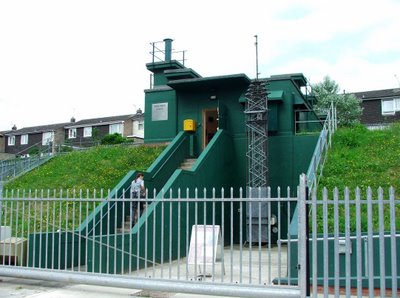
The cold war bunker at York has recently opened its doors thanks to English Heritage and a large chunk of cash (reputedly £240,000) The bunker is situated behind Shelley House on Acomb road in York, and is open for pre-arranged tours. Based on photographs of the interior in 1991, when it was 'stood' down, its appearance, including a large collection of equipment such as computers, telephones and uniforms, has been re-constructed as authentically as possible. Also in situ, are maps and recording equipment that would have been used to monitor radioactive fall out in the event of a nuclear attack on the UK.

Photography was forbidden on the tour, hence the only shot I have is of the exterior of the bunker, but needless to say, it's a tour well worth taking.

The bunker is a semi-submerged structure, built into a mound of earth a story high, and accessed by a flight of stairs up the outside. The bomb proof door is still in situ, as is the pump up arial at its side. Once inside, there are an further two floors beneath the earth.

Once inside, the bunker is pretty much like a large house (without the windows of course). There's a kitchen and canteen, dormitaries to sleep a staff of 60 in shifts, the plant room containing the deisel generator, a telephone exchange room with impressive faraday cage, the Control room from which the trajectory of radioactive material would have been monitored and all presented pretty much as it would have been when in action!!!

The tour is presented by a member of English heratige, and the young lady that took our tour was very knowledgable and answered all of our questions.

The bunker was opened for operations in 1961, and found itself on high alert during the Cuban missile crisis of 1962.

Well worth a visit.

Clifford's Tower, York

Clifford's Tower,
York
Yorkshire

Clifford's tower is perhaps the most visible and most recognisable symbol of York's military history. The tower was built in 1068 by William the conqueror, the first of two motte and bailey structures. The second, The Old Baile, was built a year later. Cliffords tower sits on the East banks of the River Ouse. Both castles would have been significant defencive structures for their day....until they were destroyed by English and Danis armies in September 1069!


By the end of the year, both castles had been rebuilt. In 1190, the keep of the motte was severely damaged by fire in the anti-jewish riots that took place in the city. Once again, the castle was re-built, this time on a higher motte.

In 1228, disaster struck again, when the wooden castle was blown down in a gale. No rebuilding work was done for 17 years, until Henry III gave instructions for the castle to be rebuilt in wood and stone. By 1270, the castle was once again complete. The castle was largely untouched until the 1660's.

The area covered by the Museum (incorporating the remaining portions of the Medieval castle walls) would have been the bailey and outbuildings of the original motte and bailey structure. The 1600's saw a period of building in the bailey region of the castle, and the keep on the motte transformed into a gaol. The tower was by this time, demoted from a defensive structure in this respect, and the castle promoted to the centre of civil administration for the city.

The tower that we see today, was rebuilt and repaired by the Cliffords in the 1700's.


Thursday, August 17, 2006

Photos of Kendal Parish church, Kendal

Kendal Parish Church
Kirkland
Kendal
Cumbria


The parish church from Castle Walk.

The church from the river side.


South wall of the church where most of the best gargoyles 'live'.


Possible late 18th, early 19th century sun dial in the church yard.

The Bellingham chapel.


Robin the Devil's sword and helmet.


Bellingham family tomb.

The clock tower at night from the opposite banks of the river Kent.

Kendal Parish church, Kendal

Kendal Parish church
Kirkland
Kendal

Kendal Parish church sits behind a set of ornate gates in Kirkland sandwiched between the road and the river Kent. There are three great views to be had of the exterior of this fine building. The first view is through the gates, with the grassed area (once almost a village green with stocks and a may pole) The second view is approaching from the right hand side, through the Parish Hall car park. This view really demonstrates the length of the church, and affords some great views of the hundreds of gargoyles that protrude from the eaves. The third view is to be had from the river side walk, showing off to great effect, the impressive width of the church. It’s interesting to note here, that the Parish Church of Holy Trinity is only around seven feet narrower than York Minster, making it probably the second widest parish church in England!!

There have been many periods of building, re-building, extension and renovation. Some of the earliest portions of the church date to the 13th century. There are also portions of the building dating to the 15th century, the 16th century, and extensive re-building and re-modelling from the 1800’s. The earliest piece of stone work to be found in the church is a 9th century piece of Anglian cross, which resides on a window sill to the East of the church.

Most days the church is open at some point, and the staff are usually enthusiastic about letting people wonder around and take photos.

The true size of the church is plain to see once you’re inside. It stretches 140 feet towards the river, and is 103 feet wide. There are dozens of memorials and plaques on the wall of the church, many of which were created by George and Francis Webster and Miles Thompson of the Kendalian firm of architects. You could spend hours looking at these alone. Many of them are dedicated to some of the most powerful families in the old counties of Westmorland and Cumberland. Famous families such as the Parr’s are represented here as well. The Parr chapel stands at the South East of the church, dating from the 14th century. The tomb is said to belong to the Grandfather of Katherine Parr, last wife of Henry VIII. The Bellingham chapel at the North East of the church, was built in the early 16th century, and includes 17th century brasses that replace the originals that were stolen. The Bellinghams were from Burneside and Levens, and had a town house in Kendal that is now occupied by Henry Roberts book shop. The Strickland chapel is situated at the East end of the church, and dates from the 13th century. The chapel is dedicated to the Stricklands of Sizergh castle a few miles outside of Kendal.

The church is sometimes referred to as the Church of Angels, an ‘alias’ derived from the multitude of carved wooden angels secreted around the church ceilings. There are four angels above the Parr chapel, and a further 14 angels above the 16th century North aisle. The Parr chapel angels are thought to be medieval, whilst the North aisle angels were positioned in 1868 when the church was being re-roofed.

High up on the North wall near the Bellingham chapel, a sword and helmet are suspended. These reputedly belonged to Robin the Devil (Sir Robert Phillipson of Belle Isle on Windermere) After his home was besieged by a local militiaman (Colonel Briggs of Kendal) Sir Robert Phillipson came to the church looking for his assailant. He rode into the church and in the process lost his helmet. The sword is probably not connected with this story, and its history seems to be unknown.

Just inside the porch, there’s a large wooden plaque, which gives the names of all the serving vicars at the Parish church……a list that goes right back to 1190 and is unbroken to this day.

Outside, the interest continues, as the church is festooned with hundreds of gargoyles. Some are modern replacements for those that have succumbed to the weather, others are Victorian gothic grotesques, others are medieval and some are even older. There are a variety of creatures, monsters, angels, and strange beasts. The best are to be seen on the South wall of the church (between the church and the car park) and extend the whole length of the building. There are some huge (probably Victorian) gargoyles, but if you look closely, you’ll see many much smaller (and stranger) gargoyles covering the eaves from front to back.

Thursday, August 10, 2006

Brougham Hall, Brougham

Brougham Hall,
Brougham,
Cumbria

Brougham Hall sits just outside Eamont Bridge near Penrith, on the B6262. The hall is a mis-mash of buildings dating from the 1400's right through to the 1930's.

Large parts of the Hall were built during the early part of the 13th century, when a cow house, great hall and a fortified manor were erected by Gilbert de Broham. A licence to crenellate was granted to Ricardus de Brun in 1307, and it is likely that the walls were built at this time. During the 16th century, further buildings were added to the interior of the site, and a pele tower was built during the 17th century. Lady Anne Clifford of Pendragon, Penrith and others fame restored the hall and its buildings around this time. The site as a whole became derelict in the late 18th century, and was largely rebuilt in the 1900's. Little of the Medieval remains are visible today, although the hall has undergone a great deal of re-building in the last decade or so. The gatehouse has been spectacularly rebuilt, as have some of the internal buildings and the wall surrounding the site.


There is a car park at the front of the hall, and entry is free if you want to have a look around the ruins.


Nearby are the ruins of Brougham castle, the Mayburgh Henge, King Arthur's Round Table, and the historic town of Penrith with its castle.

Arnside Tower, Arnisde

Arnside Tower,
Arnside,
Cumbria

Built in the late 14th century, Arnside tower is unique amongst the pele towers and tower houses of Cumbria and the South Lakes area, in that it is a free standing defensive tower that never had any surrounding buildings attached to it. It's seen its fair share of disaster and damage as well. It was seriously burnt in 1602, and suffered disasterous damage after a storm in 1884. The fire in the early part of the 17th century caused significant damage, although the structure was important enough for repairs to be made.
It was occupied until the 1680's, when the roof timbers were removed to Beetham and Knowsley. The storm, in 1884, almost totally destroyed the internal crosswall, causing the South West wall to collapse.

The walls that exist today, are around 1.2metres thick, sufficient to stand up to a small scale attack. Arnside forms part of a protective ring of pele towers standing guard over the Morecambe bay area.


Other towers in this protective ring include Hazelslack, Wraysholme and Beetham. The tower is situated on a public footpath near Arnside Tower farm sandwiched between Silverdale and Arnside, and is easily accessable for photographing, although the structure is in a very poor state of repair and should not be entered.